Clay sewer pipe: strong pipe, weak old joints
Updated October 30, 2026 · 2-minute read · Old House Sewer Lines
Clay sewer pipe is a durable material by its makers' account, but in older laterals the joints are the weak point. Clay pipe makers say lines over 70 years old may have field-made joints that do not meet current standards.
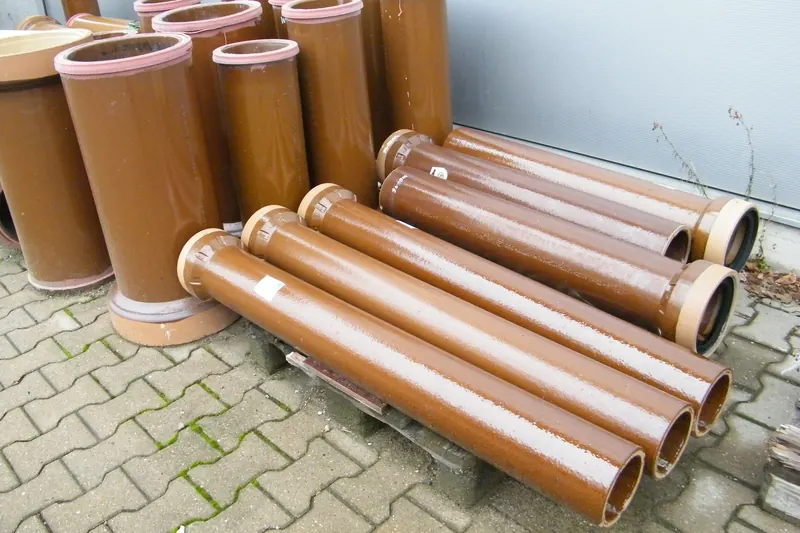
That warning comes from the National Clay Pipe Institute, the makers' trade body (NCPI FAQ). NCPI says clay pipe made in the United States since the 1950s has had flexible compression joints applied at the factory. It also says pipe made before the 1950s may not be fully vitrified and may contain laminations, both of which lower its strength.
Where roots get in
Roots go where the water vapor is. The City of Traverse City, Michigan, explains that a sewer's warm water sends moisture out into cold ground; roots trace it back to a crack or a loose joint and enter, winter included (Traverse City Tree Root FAQ). The city calls clay tile pipe easily penetrated. By the city's account PVC resists roots better, mainly because a PVC run has fewer joints, and those fit more tightly.
Once inside, roots keep growing in the airy space above the flow. Traverse City warns that the pressure they put on a joint can break the pipe and lead to total collapse. NCPI's own advice is aggressive, regularly planned cleaning as the most effective way to prevent root intrusion. See tree roots in the sewer line for the cleaning and chemical options and their limits.
What the standards say
Today's clay pipe is made to ASTM C700, which covers extra strength and standard strength vitrified clay pipe for sewage, industrial waste and storm water (ASTM C700). Under that standard, the pipe may absorb no more than 8% water, and it is tested for acid resistance. NCPI says current joints meet ASTM C425, which requires joints not to leak under shear load and deflection.
Vitrified clay remains on the list of approved building sewer materials in Table 702.3 of New York's plumbing code, under ASTM C4 and C700 (NYSPC 2020, Chapter 7). It is not on the shorter list the code allows in filled or unstable ground, which is limited to ABS, cast iron, copper, PVC and polypropylene (§ 703.2).
The 200-year claim
NCPI says only vitrified clay can document more than 200 years of service in the United States, and that the material does not deteriorate. That is the industry's own claim. The same makers' guidance on old joints and pre-1950s pipe points to where older clay laterals actually fail: at connections, and in pipe made before the 1950s.
What owners can do
FEMA's homeowner flooding guide points out that clay is one of the two usual lateral materials in older homes, and suggests swapping a failing one for newer pipe less prone to root entry, corrosion and cracking (FEMA urban flooding guidance). A sewer camera inspection shows whether the problem is a few joints or the whole run. The video also settles whether CIPP lining is possible, since a liner copies the shape of the old pipe and cannot fix a collapsed, back-pitched or fragile one. Compare with cast iron sewer pipe, the other common material under older houses, or browse the pipe materials section.
Key facts
- Clay pipe makers say installations over 70 years old may have field-made joints below current standards (NCPI).
- Pre-1950s clay may be incompletely vitrified and laminated, lowering its strength, per NCPI.
- ASTM C700 caps clay pipe water absorption at 8% (ASTM).
- Vitrified clay is approved for building sewers in New York's Table 702.3, but not for filled or unstable ground under § 703.2.
- Traverse City calls clay tile easily penetrated by roots, while PVC usually has fewer joints (Traverse City).