Orangeburg pipe: the tar-paper sewer line under older houses
Updated October 30, 2026 · 2-minute read · Old House Sewer Lines
Orangeburg pipe is bituminous fiber sewer pipe, typically made by rolling tar and paper into a tube. As it ages it flattens out of round, which narrows the line and invites clogs and roots.
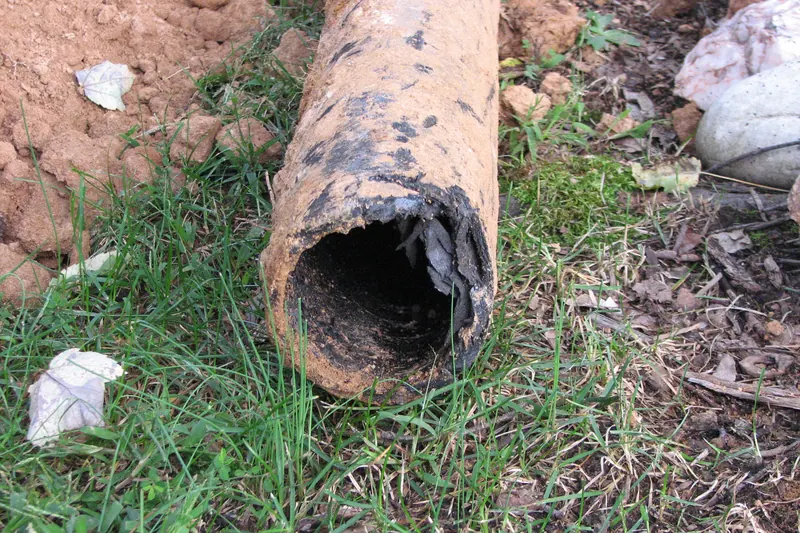
"Orangeburg" was a brand of bituminous fiber sewer pipe made by the Orangeburg Manufacturing Company, according to a building safety handout from the City of Tempe, Arizona (Tempe, Orangeburg Pipe). Tempe says the pipe was commonly used in the 1960s and 1970s for the connection from a house to the public sewer, and that its plumbing code allowed it from 1955 to 1982. Those are Arizona dates. When, and how widely, Orangeburg went into the ground in Westchester was not confirmed from a primary source.
How it fails
Tempe describes the failure plainly: as the material breaks down, the pipe is flattened and no longer keeps a round interior. Roots invade it. Mechanical clearing helps only for a while, and router tools can damage the pipe further. A line that clogs again soon after cleaning is one reason to have it filmed; see sewer camera inspection.
The material also narrows the repair choices. The City of Fairfax, Virginia, says fragile Orangeburg may be damaged by the hydro-jetting used to clean a pipe before a liner goes in, which would make it ineligible for lining (Fairfax lateral program, archived). Fairfax adds that a liner takes the shape of the host pipe, so the old pipe cannot be collapsed, back-pitched or fragile. Lining does not correct structural defects. More on that in when sewer lining won't work.
Replacing it under New York code
Bituminous fiber pipe does not appear in Table 702.3 of New York State's plumbing code, the list of materials approved for a new building sewer (NYSPC 2020, Chapter 7). That table includes PVC, ABS, cast iron, polyethylene and vitrified clay, among others. Any replacement section therefore goes in as one of the listed materials.
Pipe bursting is one route. In the 2020 code, § 716 allows bursting of gravity building sewers 6 inches and smaller, with new HDPE pipe of SDR 17 to ASTM F714, at the same nominal size, and a recorded video survey before and after. Open trench replacement is the other. EPA's 2004 report names remove-and-replace as the standard, proven repair for a failed lateral (EPA 2004, Appendix L). Options are compared in sewer line repair options.
How to tell if you have it
Tempe describes Orangeburg as the house-to-street connection, so it may not be visible from the basement at all. A camera run is the practical test; a flattened, out-of-round pipe is the sign Tempe describes. Other clues are covered in what your sewer pipe is made of.
Key facts
- Orangeburg is bituminous fiber pipe, typically tar and paper rolled into a tube (City of Tempe).
- Tempe reports common use in the 1960s and 1970s and code approval there from 1955 to 1982; New York dates are unconfirmed.
- As it deteriorates, the pipe flattens and loses its round interior.
- Fairfax, Virginia, says jetting before lining may damage it, ruling out CIPP (archived Fairfax page).
- Bituminous fiber is not on New York's approved building sewer list, Table 702.3 (ICC).