Cast iron drain and sewer pipe in older homes
Updated October 30, 2026 · 2-minute read · Old House Sewer Lines
Cast iron sewer pipe in older homes is often hub-and-spigot soil pipe: one end flares into a bell, or hub, and the plain end of the next length sits inside it. Old joints were packed with oakum and sealed with poured lead.
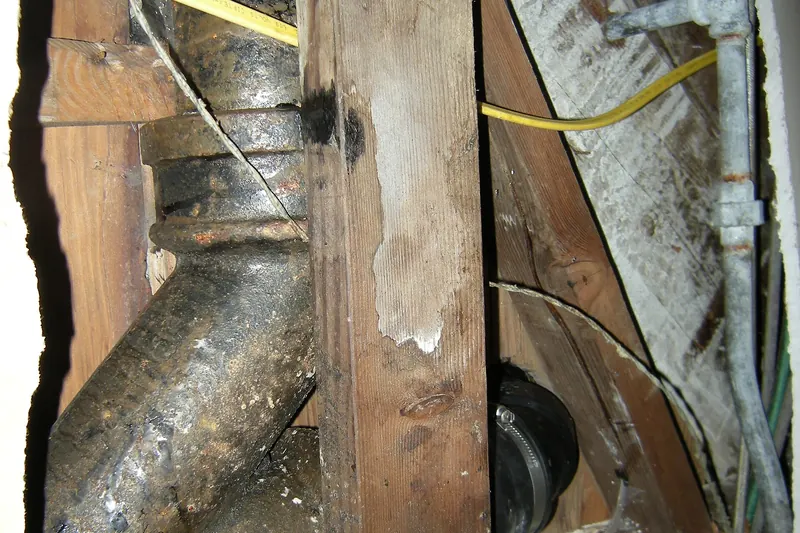
The Cast Iron Soil Pipe Institute, the makers' trade group, describes the method in its handbook (CISPI handbook). Oakum fiber is packed into the hub, molten lead is poured over it, and once the lead cools it is caulked tight with a caulking tool to form a solid metal insert. Modern hub-and-spigot joints can use a rubber compression gasket instead. The pipe is made to ASTM A74 in two wall weights, Service (SV) and Extra Heavy (XH).
No-hub pipe
The other type has no bell at all. Hubless, or no-hub, cast iron is made to ASTM A888 or CISPI 301, and its plain ends are joined by a coupling that slips over both and is tightened down. CISPI describes that coupling as a neoprene gasket inside a stainless steel shield with clamps.
All three standards, A74, A888 and CISPI 301, appear in Table 702.3 of New York's plumbing code as approved building sewer materials (NYSPC 2020, Chapter 7). Cast iron is also one of the five materials § 703.2 allows where a building sewer runs through filled or unstable ground.
How it ages
CISPI says corroding cast iron leaves behind an insoluble graphitic layer that resists further corrosion, and that in its tests this layer held pressure even where corrosion had gone through the wall. That is the makers' description. Internal scale and buildup, often called tuberculation, could not be confirmed from a primary source, so no claim is made here about how fast old pipe narrows.
What is documented is the list of defects EPA sees in aging service laterals: faulty joints, root intrusion, failed bedding and backfill, material failure and missing or damaged cleanout caps (EPA 2004, Appendix L). In one 1995 study EPA cites, cleanout caps alone accounted for nearly a quarter of the defects found. Con Edison, on its gas safety page, tells customers that loose or worn caps on indoor sewer lines let gases into the home, and that they should be sound and fastened (Con Edison gas safety). More on access points is in the sewer cleanout.
Harsh chemicals are another stress. One maker of an acid drain opener cautions on its label that aging piping can have flaws plugged by organic deposits, which the acid can open up into leaks. See drain cleaner chemicals and safety.
In the basement
Under state definitions, the building drain inside the house runs to 30 inches beyond the outside wall; from there the building sewer carries waste to the street, and its material can differ. FEMA notes that many older laterals are clay or cast iron. Older drains may also pass through a house trap before leaving. Clues for telling them apart are in identifying sewer pipe material, and the clay side in clay sewer pipe.
Key facts
- Hub-and-spigot soil pipe is made to ASTM A74 in Service and Extra Heavy weights (CISPI).
- Old hub joints are oakum packed in the bell, sealed with poured and caulked lead.
- No-hub pipe (ASTM A888, CISPI 301) joins with a gasket-and-shield coupling clamped over plain ends.
- Cast iron is approved for building sewers in Table 702.3 and in filled or unstable ground under § 703.2 (ICC).
- Nearly one lateral defect in four traced to a bad cleanout cap in a 1995 study (EPA, Appendix L).