Cured-in-place lining for a house sewer line
Updated October 30, 2026 · 3-minute read · Old House Sewer Lines
Cured in place pipe lining, or CIPP, rebuilds a sewer from the inside: a flexible tube soaked in resin goes into the cleaned old pipe and is cured into a new, jointless pipe that hugs the old one. EPA's description covers installation by air or water inversion or by pulling the liner in, then curing with hot water or steam (EPA Appendix L).
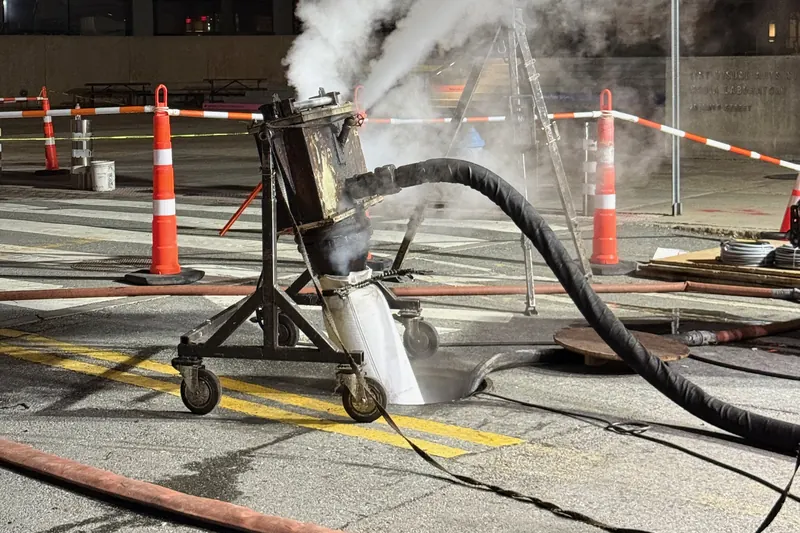
For a house lateral the attraction is fewer trenches. The limit is that the liner copies whatever pipe it is put into.
The two standards
Two ASTM standards cover the common methods. ASTM F1216 covers inverting a resin-impregnated tube into an existing pipe from 2 to 108 inches across and curing it with hot water, steam or light; the abstract says the finished pipe "will be continuous and tight-fitting" (ASTM F1216). ASTM F1743 covers pulling the resin tube into place and inflating it with a calibration hose, for pipes from 2 to 96 inches, and its listed uses include building piping (ASTM F1743). Asking which standard a contractor follows is a reasonable first question.
Preparation decides the result
EPA says the lateral must be thoroughly cleaned before the liner goes in. That usually means jetting out roots, grease and scale, then running a camera. Fairfax, Virginia's lateral program makes the camera recording the test of eligibility and says structural defects must be repaired first, because lining does not correct them (City of Fairfax, archived). Collapsed, back-pitched or fragile pipe is out; when a sewer line can't be lined covers those cases. Sewer camera inspection explains what the pre-lining video should show.
Cleaning the outdoor part of a lateral carries a gas-line caution. Jetting or cutting beyond the foundation is where NYSEG flags the rare risk of a gas pipe crossing the lateral, and the utility describes putting a camera in first as good practice (NYSEG). See cross bores.
How long a liner is meant to last
A CIPP liner is designed for about 50 years. Caltrans, summarizing a 2012 study done under an EPA program, reported that liner samples in service for 5 to 25 years were in excellent condition and that the authors saw no reason they would not reach their intended 50-year life (Caltrans). That is an encouraging early finding from a small sample, not a guarantee.
Resin and fumes
Many liners use styrene-based resin. Purdue University researchers reported that pressure applied during curing can blow the water out of plumbing traps, opening a path for styrene vapor to reach the rooms of a building (Purdue research). The same group found that resins without styrene gave off far less volatile material to the air under identical conditions, which is one reason to ask what resin a crew plans to use. After styrene concerns, New York's state transportation department tightened its own CIPP specifications for highway culverts. Styrene smell during lining goes further.
Lining is licensed contractor work. Ask the city or village building department whether a permit applies; this site found no confirmed town-by-town permit rules for lining. No current government price range exists.
Key facts
- ASTM F1216 covers inverted CIPP in pipes 2 to 108 inches; F1743 covers pulled-in-place CIPP in pipes 2 to 96 inches, including building piping (ASTM).
- EPA says the lateral must be thoroughly cleaned before lining (EPA).
- Lining does not fix structural defects; Fairfax, Virginia uses the CCTV recording to decide eligibility.
- Liners are designed for about 50 years; a 2012 study of 5- to 25-year-old samples was encouraging (Caltrans).
- Purdue research found curing pressure can displace trap seals and let styrene-laden air indoors (Purdue).
Sources
- ASTM F1216 — Rehabilitation by inversion of a resin-impregnated tube
- ASTM F1743 — Pulled-in-place installation of cured-in-place pipe
- EPA — Appendix L, service lateral rehabilitation (2004)
- Caltrans — Preliminary investigation: cured-in-place pipe (2012)
- Purdue University — CIPP safety reports
- City of Fairfax, VA — Lateral repair program (Wayback copy)