How tree roots get into sewer lines
Updated October 30, 2026 · 3-minute read · Old House Sewer Lines
Tree roots get into a sewer line through cracks and loose joints that are already there, drawn by warm, moist air escaping from the pipe into cooler soil. Once inside, they grow in the open space above the flowing water and can eventually break the pipe apart.
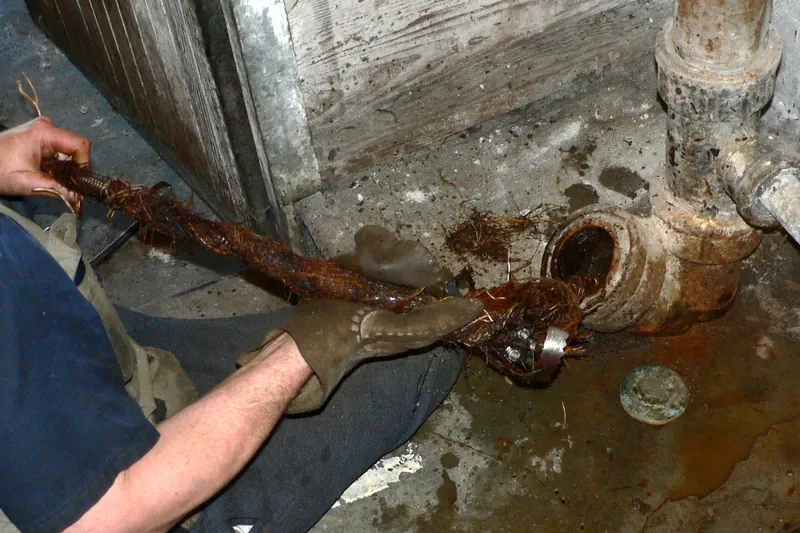
The City of Traverse City, Michigan, which runs its own sewer utility, sets out the sequence in its tree root guidance. Warm water in the line gives off vapor into the surrounding cold soil. Roots follow that vapor trail to its source, usually a crack or a loose joint, and grow through it. The city notes this continues through the winter (Traverse City).
Why the pipe is attractive
The University of Tennessee Extension puts it plainly: a sewer pipe contains the three things a tree needs, which are water, nutrients and oxygen (UT Extension). Pipe condition, species and soil together set how bad an invasion gets.
Oxygen is the limiting factor. Traverse City says roots need it to grow and do not grow in pipes that run full of water. They thrive in the damp air gap above the flow line in a normal, partly full lateral. That is also why foaming root killers are designed to reach the top of the pipe; see copper sulfate and foaming root killers.
How far roots reach
Distance is less protection than many owners assume. A 40-foot tree, by Traverse City's general rule of 2.5 times height, can send roots about 100 feet out; the city says certain species go five to seven times as far. UT Extension says no species earns the label "sewer-safe" and advises keeping new plantings over 10 feet from the line. A list of species to avoid is in trees to avoid near sewer lines.
Old pipe gives them a way in
Many laterals in southern Westchester are clay or cast iron; how much Orangeburg (bituminous fiber) pipe is in the ground here could not be confirmed. Traverse City found clay tile easy for roots to enter; plastic pipe holds them off better, the city says, chiefly because its joints are fewer and fit more snugly. The National Clay Pipe Institute, the clay industry's trade body, concedes two weak points in old clay: joints formed in the field on lines more than 70 years old may not meet today's standards, and pipe fired before the 1950s may be less strong (NCPI). See clay sewer pipe.
Once a root is inside, growth does the damage. Traverse City says the force of the expanding root presses on the crack or joint it entered and can break the pipe, sometimes leading to total collapse. EPA lists root intrusion among the most common lateral defects in its review of private-side repairs (EPA, Appendix L).
Westchester County treats the house lateral as the owner's pipe, so a root problem in it is the owner's to fix. Rye and the Village of Mamaroneck go further and write root-free laterals into their sewer codes, alongside grease and solids. For other municipalities, check with the building department.
What clears them
Roots are removed mechanically, by a contractor with a cable machine and cutting head or a jetter, usually after a sewer camera inspection. EPA says chemical root control has to be combined with another cleaning method to remove the roots it kills. Before any cutting tool goes into the yard section of the pipe, a camera should rule out a gas line bored through it. National Grid notes that most blockages are tree roots, grease or other ordinary clogs, but in rare cases a utility line has been pierced straight through the sewer (National Grid).
Video from LA Sanitation & Environment, an outside channel: LA Sanitation explains how roots seek moisture, enter laterals through cracks and joints, and how owners can prevent damage. Nothing loads from YouTube until you press play.
Key facts
- Roots follow vapor from warm sewer water to cracks or loose joints, and this goes on in winter, per Traverse City (Traverse City).
- Because roots need oxygen, they colonize the gap over the water, not pipes that flow full (Traverse City).
- Traverse City's general rule: a root zone reaching about 2.5 times tree height (Traverse City).
- UT Extension says to keep trees over 10 feet from sewer lines (UT Extension).
- EPA says chemical root control must be paired with another method to remove dead roots (EPA).