The house trap: the U-shaped fitting in many older New York basements
Updated October 30, 2026 · 3-minute read · Old House Sewer Lines
A house trap is a U-shaped fitting on the main building drain, typically found in the basement, that holds water so that sewer air cannot circulate up into the house drain system. New York's plumbing code now prohibits installing them, but existing traps in older homes may stay.
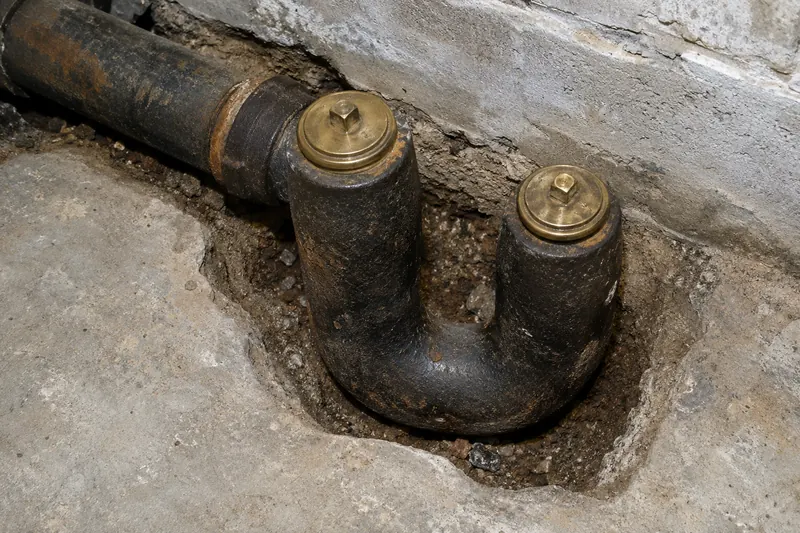
The NYS Department of State defines a building trap as "a device, fitting or assembly of fittings installed in the building drain to prevent circulation of air between the drainage system of the building and the building sewer" (NYS DOS, Building Traps). §1002.6 of the Plumbing Code of New York State is one sentence long: building (house) traps are prohibited (NYS code chapter 10). The ban survived into the current 2025 code, which took effect on the last day of 2025.
Why the code turned against them
DOS gives two reasons. The trap is redundant, because every fixture in the house already has its own water-seal trap that blocks sewer gas; under §1002.4 that seal must be at least 2 inches deep and no deeper than 4. DOS also warns the trap itself can become the spot where the drain clogs. Everything leaving the house has to pass through one more bend, and solids can settle there. Clogs at the trap are covered in house trap clogs.
The change came in stages. New York's residential code first prohibited building traps in new construction in 2003, with exceptions allowed for local conditions. Those exceptions ended with the 2016 update, and the 2020 residential code prohibits them without exception in new homes.
What an existing trap means for you
An old trap can remain in place. The line between old and new comes when the plumbing is altered: DOS says altered plumbing has to meet the rules that apply to new installations. The same guidance runs the other way too. An owner who wants a new trap added has to get a variance first, and no city, town or village can make traps mandatory on a building drain.
Removing a trap is plumbing work for a licensed plumber with a permit. Since some houses have no other access point to the drain where it heads outside, pulling the trap can mean fitting new cleanouts. The full process is in removing a house trap, and cleanout rules are in where the sewer cleanout is.
The parts around it
Because a trap can double as the cleanout, it has capped openings that a plumber uses to clear the trap and reach the line toward the street. On the house side there is often a vent pipe that runs outdoors. It is widely called a fresh-air inlet, a name DOS calls inaccurate because a vent moves air in both directions; see the fresh-air inlet.
Background
By definition the trap sits in the building drain, the piping inside the house. Per the definitions in the DOS bulletin, that drain carries on for 30 inches of pipe beyond the outside walls before it becomes the building sewer, the stretch that continues on to the public line. Who owns and maintains that outside section is a separate question, covered in who owns the sewer line. The trap, being indoors, is plainly the owner's plumbing, and the decision to keep or remove it rests with the owner, a licensed plumber and the local building department.
Key facts
- §1002.6 of the Plumbing Code of New York State prohibits building (house) traps (ICC).
- DOS calls the house trap redundant because each fixture has its own trap seal (NYS DOS).
- Building traps were first barred in new construction in the 2003 RCNYS; exceptions ended in 2016.
- A variance is needed to add a new house trap, and towns may not mandate them.
- Fixture trap seals must be between 2 and 4 inches deep (§1002.4).