Hydro jetting or a cable machine: how sewer lines get cleared
Updated October 30, 2026 · 2-minute read · Old House Sewer Lines
Hydro jetting clears a sewer line by aiming a high-pressure stream of water at the blockage, while a cable machine spins a rod or cable with a blade on the end to cut through it. Both are standard tools. Which one fits depends on what the clog is, what the pipe is made of, and whether anyone has looked inside first.
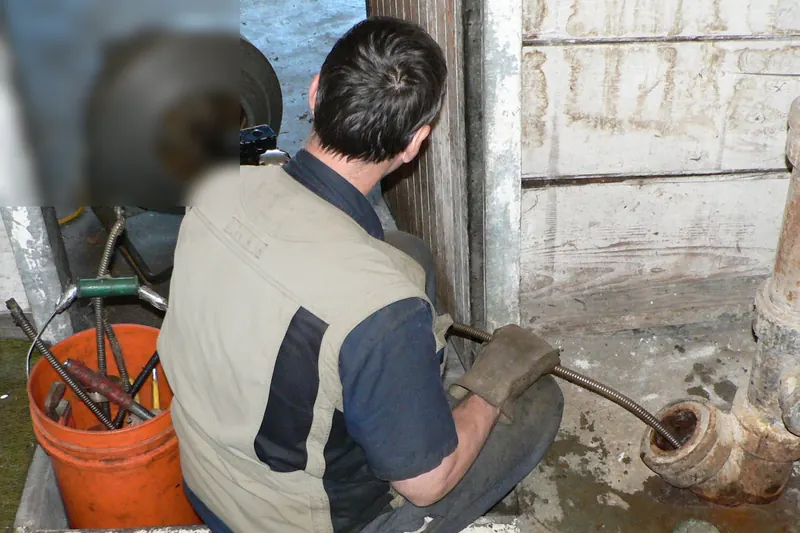
EPA's review of sewer cleaning methods describes a power rodder as a machine that drives a rotating rod through the line, shattering debris and slicing off roots that protrude into the pipe. Rodding does not remove what it breaks up, so EPA says it works best combined with flushing (EPA, Appendix L). Jetting, the same report says, is the most common hydraulic cleaning method and is most effective in smaller pipes, under 15 inches. A house lateral is well inside that range.
| Cable (rodding) machine | Hydro jetter | |
|---|---|---|
| How it works | Rotating rod or cable with a cutting blade | High-pressure water stream from a nozzle |
| Removes debris | No, breaks it up; flushing needed | Yes, washes it downstream |
| Roots | Cuts roots that hang into the pipe | Clears loose material; can wash out cut roots |
| Main risk | Blade can snag or cut whatever is in the pipe | Can flood a basement if too much water goes in |
The risks with each
EPA warns that jetting can cause basement backups when the hose is fed into a service line by mistake, or when more water goes in than the line can carry. That is mostly a problem for crews jetting street mains, but the principle applies to a partly blocked lateral too.
Cutting tools carry a different risk: a gas line bored through the sewer pipe during utility work, known as a cross bore. National Grid's guidance for plumbers says to look for trees and landscaping that would explain a root clog, to run a camera first, and, if no camera is available, to use a hydro-jetter rather than a cutting tool (National Grid). NYSEG says clogs inside the building are not a cross-bore concern, but clogs outside could be (NYSEG). Details are in cross bores.
Pipe material matters
Old pipe can be damaged by either tool. Tempe, Arizona's building safety office says bituminous fiber pipe, sold as Orangeburg, flattens out of round as it ages, that router tools can damage it further, and that mechanical clearing helps only for a while (City of Tempe, archived). Fairfax, Virginia notes that fragile Orangeburg may be damaged by the jetting used to clean a pipe before lining, which can rule out a liner altogether (City of Fairfax, archived). See Orangeburg pipe.
Clay pipe makers lean the other way on roots. Their trade body, the National Clay Pipe Institute, ranks scheduled, vigorous cleaning above every other method for root prevention (NCPI). That is an industry position; it does not fix the cracked joints roots get through.
Before lining
If a lateral is going to be lined, it is cleaned first. EPA says the pipe must be thoroughly cleaned before a cured-in-place liner goes in, and jetting is the usual method. A camera inspection before and after cleaning shows whether the pipe is sound enough; see CIPP sewer lining.
Both machines are contractor equipment. Homeowner scope ends at stopping water use and calling a licensed plumber.
Key facts
- EPA says rodding cuts roots and breaks up debris but does not remove it, so it works best with flushing (EPA).
- EPA calls jetting the most common hydraulic method, most effective in pipes under 15 inches (EPA).
- Jetting can cause basement backups if too much water enters a line, per EPA (EPA).
- Without a camera, National Grid tells plumbers to use a jetter, not a cutting tool (National Grid).
- Fairfax, VA says fragile Orangeburg may be damaged by pre-lining jetting (Fairfax, archived).