Why no one should climb into a manhole or sewer pit
Updated October 30, 2026 · 3-minute read · Old House Sewer Lines
A manhole is a confined space: no one without training, air testing and rescue gear should go down into one, or into a sewer pit or septic tank, because the air inside can lack oxygen and hold toxic gas. If someone collapses inside, do not go in after them. Call 911.
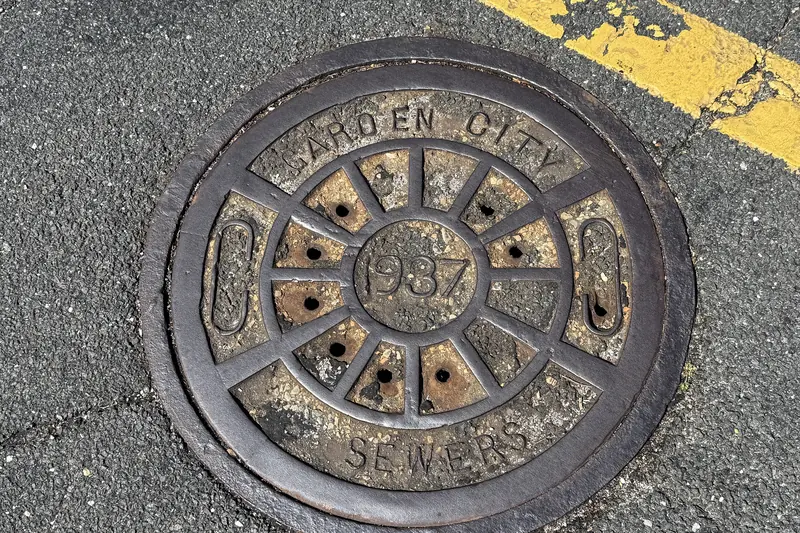
The National Institute for Occupational Safety and Health (NIOSH) says all manholes should be treated as confined spaces with potentially hazardous atmospheres, with the air tested before each entry and while anyone is inside (NIOSH 98-122). That standard is written for trained workers carrying air monitors. A homeowner has neither the training nor the equipment.
A New York case
In September 2010, a 48-year-old village Department of Public Works employee in New York went down an 18-foot sewer manhole to clear a blockage. A 51-year-old volunteer firefighter went in after him. Both died. The NYS Department of Health's Fatality Assessment and Control Evaluation report, 10NY060, gives the cause of death for both as asphyxia from low oxygen and exposure to sewer gases (NYS DOH FACE 10NY060). The report says the firefighter entered without any respiratory protection.
That pattern repeats. NIOSH puts chain-reaction rescuer deaths at 36 percent of confined-space deaths. A NYS Department of Health training module puts would-be rescuers at more than 60 percent of documented deaths, and states in capital letters that no one should ever enter a confined space to rescue another worker, but should call 911 (NYS DOH module). The figures differ by source; both show a large share of the dead went in to help. The same module says around 100 workers die in confined spaces each year in the United States.
What makes it a confined space
Federal rules define a confined space as one large enough to enter, with limited ways in or out, and not designed for people to stay in (29 CFR 1910.146). A space becomes permit-required when it holds, or could hold, a hazardous atmosphere. OSHA calls air with less than 19.5 percent oxygen by volume oxygen-deficient.
Sewer air can be short on oxygen and carry hydrogen sulfide, which is heavier than air and settles low. The DOH module also lists flammable atmospheres such as methane. At about 100 ppm, hydrogen sulfide deadens the sense of smell within minutes, so a nose is no guide. More on that in hydrogen sulfide and sewer gas.
What a homeowner does instead
Street manholes belong to the municipal sewer system. If a backup looks like it is in the main, the town's crews check it. In Mount Vernon, the city's sewer plan describes crews checking the flow in the nearby manholes; if both show normal flow, the owner is told the problem is in the private lateral. See sewer main vs lateral.
A backwater valve in an outdoor pit is part of the owner's lateral, FEMA says, but that is no reason to climb into a pit or anything deeper; questions about access go to a licensed plumber. See backwater valve maintenance and the safety topic page.
Video from Workplace Safety and Health Council, an outside channel: A dramatized case shows three workers killed by hydrogen sulfide in a manhole, two of them while rushing in to rescue. Nothing loads from YouTube until you press play.
Key facts
- NIOSH says every manhole should be treated as a confined space with a potentially hazardous atmosphere (NIOSH).
- In the 2010 New York case 10NY060, a DPW worker and a volunteer firefighter died of asphyxia from low oxygen and sewer gases (NYS DOH).
- Rescuers account for 36 percent of confined-space deaths per NIOSH, and over 60 percent per the NYS DOH module (NIOSH; NYS DOH).
- Air under 19.5 percent oxygen is oxygen-deficient under federal rules (eCFR).
- About 100 US workers die in confined spaces each year (NYS DOH).