How a backwater valve keeps the sewer out of the basement
Updated October 30, 2026 · 2-minute read · Old House Sewer Lines
A backwater valve is a one-way fitting on the house sewer line: wastewater flows out normally, and when the municipal sewer overloads and pushes back, the valve closes so sewage cannot rise into the basement. FEMA describes it as the main device for that job in its urban flooding guidance for homeowners.
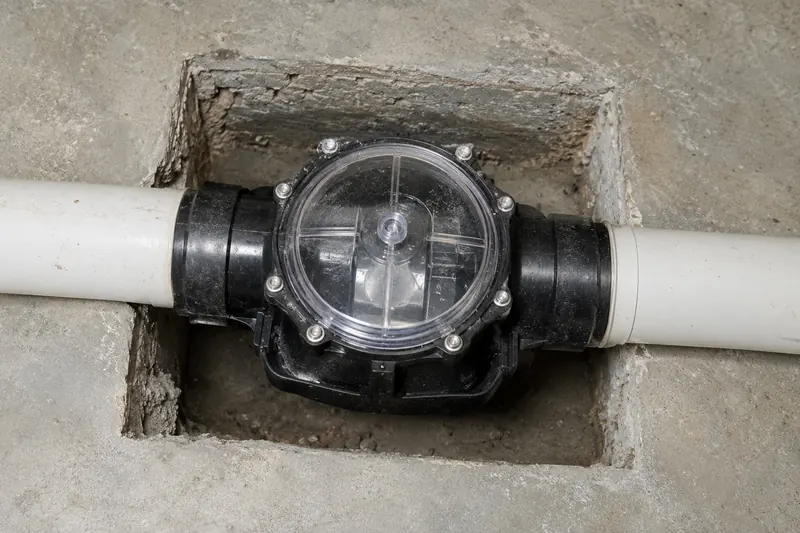
Where it sits matters for upkeep. FEMA says valves are typically installed in the sewer lateral outside the building, in a pit with an access cover, though some types go into the basement floor (FEMA). The state plumbing code requires the working parts to be reachable, and §714.1 makes a valve mandatory where fixtures sit below the next upstream public-sewer manhole cover; when the code requires one covers that test.
Three designs
| Type | How it closes | FEMA's caution |
|---|---|---|
| Check (flap) valve | Automatically, when flow reverses | Debris can hold it open |
| Gate valve | By hand | No protection unless someone closes it |
| Check plus gate | Automatic, with a manual backup | Most effective, per FEMA P-2181 |
A check valve needs no one at home. A flap or similar mechanism swings shut when flow reverses. The trade-off is that debris can stick it open, so FEMA says to inspect and clean it every few years.
A gate valve is closed by the owner. FEMA says it seals better and is unlikely to be jammed by debris, but it costs more and does nothing if nobody is there to shut it before a storm. It also needs to be opened and closed now and then so it keeps turning freely.
FEMA's handbook for public facilities says a combination of a check valve and a gate valve "provides the most-effective protection against sewage backflow" (FEMA P-2181).
Living with a closed valve
A closed valve works in both directions. FEMA warns that when the valve shuts, water used inside the house cannot drain out and may back up indoors. During heavy storms, hold off on toilets, sinks, showers, the washing machine and the dishwasher until the street sewer recovers. Heavy-rain backups and the reasons for them are covered in why sewers back up in heavy rain.
FEMA also describes an overhead sewer as an alternative. Basement fixtures drain to a sump, and an ejector pump lifts the waste to a pipe near the ceiling that drains by gravity to the lateral.
Who installs and who owns it
FEMA says plumbing permits are required, and that a backwater valve is part of the sewer lateral, so it is the owner's property and "will not be maintained by the municipality." In Westchester that means a county-licensed plumber and a permit from the local building department; see Westchester plumber and contractor licences. The owner's part of the job afterwards is set out in backwater valve upkeep.
No current government price range exists. FEMA's community flood guide, written around 2005, put backwater valves and overhead sewers at $3,000 to $5,000, a figure useful only as an old federal estimate (FEMA 511).
Video from thecityoftoronto, an outside channel: A City of Toronto staffer explains why sewers back up in heavy rain and how a backwater valve closes to keep sewage out. Nothing loads from YouTube until you press play.
Key facts
- FEMA: the valve lets wastewater out but stops sewage entering when municipal mains are overloaded (FEMA).
- Check valves close on their own but can be held open by debris; FEMA says inspect and clean them every few years.
- Gate valves seal better but protect only when closed by hand.
- FEMA P-2181 calls a combined check and gate valve the most effective option (FEMA P-2181).
- While the valve is closed, water used indoors cannot drain, so avoid fixtures during heavy storms.
- FEMA 511's $3,000 to $5,000 range dates from about 2005 (FEMA 511).